The US version of The Supplement Compare is currently being prepared and will be available soon.
KPV Research Peptides
Compare KPV research products by exact form, labelled quantity, price per mg, testing evidence and product transparency. Read what the preclinical evidence actually shows for gut inflammation, wound healing and skin delivery, and why human dose, half-life and safety remain unknown.
Research-use products only. Not presented as supplements, medicines, or products for human or veterinary consumption.
KPVLys-Pro-Val · three-amino-acid alpha-MSH fragment
Displayed points and weights are rounded; the total uses unrounded weights. Pending dimensions are excluded. Provisional scores may change after review.
Quantity
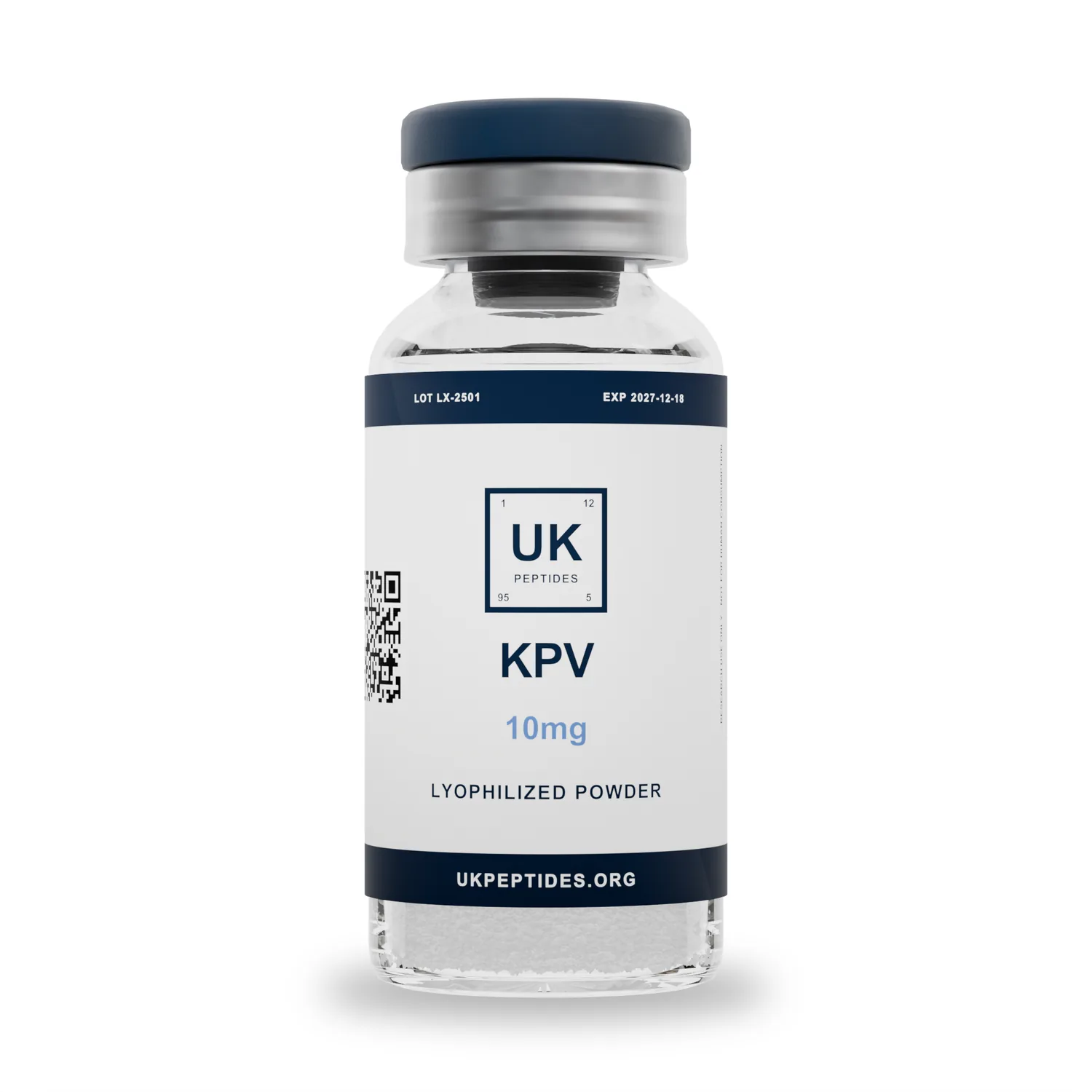
10 mg / vial
Testing evidence
Evidence status
Manufacturer COA
Manufacturer statement
Independently Tested · Accredited External Lab; Third-party HPLC-UV testing; lot-matched CoA on every order; batch-traceable from dispatch.
Displayed points and weights are rounded; the total uses unrounded weights. Pending dimensions are excluded. Provisional scores may change after review.
Testing evidence
Evidence status
Manufacturer COA
Manufacturer statement
Independently Tested · Accredited External Lab; Third-party HPLC-UV testing; lot-matched CoA on every order; batch-traceable from dispatch.
Displayed points and weights are rounded; the total uses unrounded weights. Pending dimensions are excluded. Provisional scores may change after review.
Quantity
10 mg / vial
Testing evidence
Evidence status
Manufacturer COA
Manufacturer statement
Independently Tested · Accredited External Lab; Third-party HPLC-UV testing; lot-matched CoA on every order; batch-traceable from dispatch.
Displayed points and weights are rounded; the total uses unrounded weights. Pending dimensions are excluded. Provisional scores may change after review.
Testing evidence
Evidence status
Manufacturer COA
Manufacturer statement
Independently Tested · Accredited External Lab; Third-party HPLC-UV testing; lot-matched CoA on every order; batch-traceable from dispatch.
Displayed points and weights are rounded; the total uses unrounded weights. Pending dimensions are excluded. Provisional scores may change after review.
Quantity
10 mg / vial
Testing evidence
Evidence status
Manufacturer COA
Manufacturer statement
Independently Tested · Accredited External Lab; Third-party HPLC-UV testing; lot-matched CoA on every order; batch-traceable from dispatch.
Displayed points and weights are rounded; the total uses unrounded weights. Pending dimensions are excluded. Provisional scores may change after review.
Testing evidence
Evidence status
Manufacturer COA
Manufacturer statement
Independently Tested · Accredited External Lab; Third-party HPLC-UV testing; lot-matched CoA on every order; batch-traceable from dispatch.
Displayed points and weights are rounded; the total uses unrounded weights. Pending dimensions are excluded. Provisional scores may change after review.
99.3{4126ccafc2fa8f847ceaeb6a91497cc67cd381373337e0df85dd9df95f3d94fa} HPLC purity; "independently verified by HPLC and LC-MS before release"; "Every batch is analyzed by an accredited third-party laboratory"; "bioburden testing and LAL endotoxin assays are conducted per USP guidelines on a batch-sample basis."
Laboratory
Not recorded
Certification body
Not recorded
Batch
Not recorded
Batch-specific report
Not established in this record
Report date
Not recorded
Evidence checked
2026-09-20
Why this score?
Testing & analytical evidence
10/45
Value
7/25
Product identity
11/15
Supplier transparency
3/10
Label & listing transparency
5/5
Displayed points and weights are rounded; the total uses unrounded weights. Pending dimensions are excluded. Provisional scores may change after review.
Displayed points and weights are rounded; the total uses unrounded weights. Pending dimensions are excluded. Provisional scores may change after review.
Quantity
10 mg / vial
Testing evidence
Evidence status
Manufacturer COA
Manufacturer statement
Independently Tested · Accredited External Lab; Third-party HPLC-UV testing; lot-matched CoA on every order; batch-traceable from dispatch.
Displayed points and weights are rounded; the total uses unrounded weights. Pending dimensions are excluded. Provisional scores may change after review.
Quantity
5 mg / vial
Testing evidence
Evidence status
Testing claimed
Manufacturer statement
99.3{4126ccafc2fa8f847ceaeb6a91497cc67cd381373337e0df85dd9df95f3d94fa} HPLC purity; "independently verified by HPLC and LC-MS before release"; "Every batch is analyzed by an accredited third-party laboratory"; "bioburden testing and LAL endotoxin assays are conducted per USP guidelines on a batch-sample basis."
99.3{4126ccafc2fa8f847ceaeb6a91497cc67cd381373337e0df85dd9df95f3d94fa} HPLC purity; "independently verified by HPLC and LC-MS before release"; "Every batch is analyzed by an accredited third-party laboratory"; "bioburden testing and LAL endotoxin assays are conducted per USP guidelines on a batch-sample basis."
Laboratory
Not recorded
Certification body
Not recorded
Batch
Not recorded
Batch-specific report
Not established in this record
Report date
Not recorded
Evidence checked
2026-09-20
No products match these filters.
What is KPV?
KPV is the three-amino-acid peptide Lys-Pro-Val. The free-acid form is H-Lys-Pro-Val-OH, with formula C16H30N4O4, molecular weight 342.43 g/mol and CAS 67727-97-3. [S1][S3] The letters K, P and V are the standard one-letter codes for lysine, proline and valine. The same three residues occupy positions 11–13 at the C terminus of alpha-melanocyte-stimulating hormone (alpha-MSH), which is why KPV is widely described as alpha-MSH(11–13). [S2][S15] Most KPV research concerns anti-inflammatory signalling, intestinal inflammation and experimental wound-healing models rather than human treatment.
Identity matters: FDA evaluated KPV free base and KPV acetate as distinct bulk drug substances, and separately excluded N-acetylated KPV and a KPV dimer from its KPV assessment. [S3]
What does the KPV research actually show?
The evidence base is preclinical. Cell studies and mouse models report anti-inflammatory effects, with particularly consistent research in experimental colitis. [S6][S7][S8][S13][S14] Rabbit corneal-injury experiments also reported faster epithelial repair after topical KPV. [S9] Human cells and human cadaver skin have been used in laboratory studies, but that is not the same as administering KPV to people. FDA's 2026 review found no clinical studies or human exposure data for KPV free base or acetate by any route. [S3][S4]
Gut inflammation
KPV reduced inflammatory signalling in human intestinal/T-cell cultures and improved several mouse colitis models.
Human cells + animal evidence
Wound healing
Topical KPV accelerated corneal epithelial repair in rabbits, while later reviews describe cutaneous wound healing as a candidate area needing clinical testing.
Animal evidence
Human treatment
FDA found no clinical studies or human exposure data for KPV free base or acetate via any route.
No human administration evidence
Mechanism
NF-kB, inflammatory cytokines and PepT1 transport are implicated, but FDA concluded that KPV's molecular target remains unresolved.
Mechanistic evidence
Research area
What was studied
Evidence level
Inflammatory bowel disease
Human intestinal/T-cell cultures plus multiple chemically or immune-induced mouse colitis models
Preclinical
Wound healing
Rabbit corneal epithelial injury and laboratory/cell work
Preclinical
Skin delivery
Dermatomed human cadaver skin with passive diffusion, microneedles and iontophoresis
Ex vivo human tissue
Human treatment
No KPV free-base/acetate administration study identified by FDA
Evidence gap
Claims for Crohn's disease, ulcerative colitis, eczema, psoriasis, systemic inflammation or wound treatment remain research hypotheses unless supported by human KPV trials.
KPV and gut inflammation: the strongest research area is still preclinical
A 2008 Gastroenterology study exposed human intestinal epithelial cell lines and Jurkat T cells to inflammatory stimuli and found that nanomolar KPV reduced NF-kB/MAP-kinase signalling and pro-inflammatory cytokine secretion. [S6] The same study reported KPV uptake through the PepT1 di-/tripeptide transporter and reduced inflammation in DSS- and TNBS-induced mouse colitis. A separate 2008 study found earlier recovery, stronger weight regain, reduced histological inflammation and lower myeloperoxidase activity in KPV-treated mouse colitis models, including mice with nonfunctional MC1R. [S7] These findings make intestinal inflammation a credible research focus, but they do not show that KPV treats ulcerative colitis or Crohn's disease in people.
Human intestinal cells
KPV reduced inflammatory signalling in Caco2-BBE and HT29-Cl.19A intestinal epithelial cells and in Jurkat T cells.
Human-cell laboratory evidence
Mouse colitis
DSS, TNBS and transfer-colitis models showed reduced inflammatory measures or improved recovery with KPV.
Animal intervention
Clinical IBD
No KPV free-base or acetate human IBD trial was identified by FDA in its 2026 review.
Not established
Do not use the human K(D)PT ulcerative-colitis trial as KPV evidence. K(D)PT is Lys-D-Pro-Thr, a different tripeptide. [S17]
How might KPV work? PepT1 is supported, but the molecular target is unresolved
KPV does not behave like a simple shortened version of alpha-MSH at classical melanocortin receptors. In mouse inflammation experiments, its effects persisted despite pharmacological blockade or nonfunctional melanocortin receptors, and KPV did not produce the cAMP response expected from conventional receptor activation. [S8] In intestinal research, KPV was transported into epithelial and immune cells through PepT1, and later mouse work found that KPV's protective effect in colitis-associated tumour models depended on PepT1. [S6][S13] NF-kB and inflammatory cytokine pathways are repeatedly implicated, but FDA's 2026 review concluded that the underlying molecular target remains unknown. [S3]
PepT1 transport
KPV is transported by the PepT1 di-/tripeptide transporter in intestinal and immune-cell research.
Mechanistic evidence
NF-kB signalling
Several studies report suppression of inflammatory signalling or downstream cytokines, including NF-kB-linked effects.
Cell/animal evidence
Melanocortin receptors
KPV's anti-inflammatory effects appear at least partly independent of classical melanocortin-receptor signalling.
Mechanism not settled
Avoid copy saying KPV 'works by blocking NF-kB' as though one direct molecular target has been proven. The pathway is implicated; the molecular target remains unresolved. [S3]
Oral KPV research often depends on intestinal transport or engineered delivery systems
Oral delivery appears in mouse KPV research because PepT1 can transport small peptides and becomes more relevant in inflamed colon tissue. [S6] Later researchers developed hyaluronic-acid-functionalised nanoparticles and hydrogel systems to concentrate KPV in inflamed colonic tissue. In a 2017 mouse ulcerative-colitis model, the targeted HA-KPV nanoparticle system produced stronger anti-inflammatory and mucosal-healing effects than a less-targeted KPV nanoparticle/hydrogel comparator. [S14] That result belongs to a specific engineered delivery system and should not be transferred directly to ordinary KPV capsules or solutions.
Delivery approach
Research model
Key limitation
Free KPV in intestinal research
Human cell lines and mouse colitis models
Does not establish human oral bioavailability
HA-functionalised KPV nanoparticles
Mouse ulcerative-colitis model
Engineered formulation; not equivalent to plain KPV capsules
Commercial oral products
No controlled human KPV trial identified
Human exposure, PK and effective dose unknown
When future suppliers sell capsules, do not award evidence credit merely because an animal study used an oral route; formulation and human bioavailability are separate questions.
Wound healing: positive rabbit data, but no human KPV wound trial
The most direct wound-healing experiment used mechanically denuded rabbit corneas. [S9] Rabbits received topical KPV at several concentrations after epithelial abrasion, and by 60 hours all eight KPV-treated corneas in the reported group were re-epithelialised compared with none of the placebo-treated corneas. Cultured rabbit corneal epithelial cells also showed increased viability at selected KPV concentrations. [S9] This is meaningful animal evidence for epithelial repair, but it is not a human skin-wound study. A 2019 review described KPV and the related K(D)PT peptide as future candidates for cutaneous wound research and explicitly framed clinical testing as future work. [S16]
Rabbit cornea
Topical KPV accelerated re-epithelialisation after experimental corneal abrasion.
Animal evidence
Human wounds
FDA did not identify clinical evidence for KPV in wound healing, and the 2019 review describes clinical investigation as still needed.
Human evidence absent
Do not generalise a rabbit corneal-injury experiment into proven healing of human skin wounds, ulcers, tendons or surgical injuries.
Topical KPV has a delivery problem: passive penetration through human skin was below detection
A 2017 laboratory study used dermatomed human cadaver skin to test KPV transport. [S10] Passive KPV permeation was below the study's 0.01 microgram/mL detection limit. Microneedle treatment increased permeation, and iontophoresis or combined iontophoresis plus microneedles increased it further. [S10] FDA highlighted the same finding in 2026: poor passive skin permeability could reduce systemic exposure, but it may also limit access to deeper epidermal layers and therefore limit topical effectiveness. [S3] This is ex-vivo skin research, not a trial of a KPV cream in living people.
Passive application
KPV permeation through cadaver human skin was below the analytical detection limit in the study.
Ex-vivo human skin
Microneedles / iontophoresis
Physical enhancement substantially increased KPV passage and skin retention in the laboratory model.
Delivery research
Human cadaver skin is human tissue, but this does not count as human exposure, clinical efficacy or human pharmacokinetics.
Antimicrobial claims have laboratory support, but replication is not clean
A 2000 laboratory paper reported that alpha-MSH and its KPV C-terminal fragment reduced growth or viability of Staphylococcus aureus and Candida albicans. [S11] A later 2009 letter attempted to reproduce anti-Candida effects and reported no growth-inhibitory effect in its initial assay, with only a mild effect for full-length alpha-MSH under another assay condition. [S12] That conflict matters: antimicrobial activity should be described as an in-vitro research finding with reproducibility uncertainty, not as evidence that KPV treats bacterial or fungal infection in people.
No human infection-treatment study of KPV was identified.
Colitis-associated tumour research does not make KPV an anti-cancer treatment
A 2016 mouse study examined the PepT1 transporter in inflammation-driven colorectal tumorigenesis. [S13] In the AOM/DSS model, KPV reduced tumorigenesis in wild-type mice but not PepT1-knockout mice, supporting a PepT1-dependent anti-inflammatory mechanism. Human colorectal biopsy material in the same study was used to examine PepT1 expression; people were not given KPV. [S13] This is best interpreted as mechanistic colitis-associated-cancer research, not evidence that KPV prevents or treats human colorectal cancer.
Keep cancer language especially narrow: the intervention evidence is in mice.
Has KPV actually been tested in people?
FDA's 2026 assessment searched PubMed, Embase, ClinicalTrials.gov, adverse-event databases and other sources and stated that it did not identify products containing KPV free base or acetate administered in humans. [S3] It also found no human pharmacokinetic or pharmacodynamic study by any route and no clinical safety study or human exposure dataset. [S3] This distinction is easy to miss because several KPV papers use human intestinal cell lines or human cadaver skin; those are laboratory systems, not participants receiving KPV. [S6][S10]
Human cells
Human intestinal epithelial and T-cell lines have been used to study inflammatory signalling and PepT1 transport.
Laboratory evidence
Human skin
Cadaver skin has been used for permeability experiments.
Ex-vivo evidence
Human participants
No KPV free-base or acetate administration study was identified by FDA.
No clinical exposure identified
A human Phase IIa ulcerative-colitis study exists for K(D)PT, not KPV. [S17]
KPV and K(D)PT are different peptides — the human K(D)PT trial cannot be used as KPV evidence
KPV is Lys-Pro-Val. K(D)PT is Lys-D-Pro-Thr, a different tripeptide with different residues and stereochemistry. [S16][S17] K(D)PT progressed into a randomised, double-blind Phase IIa human ulcerative-colitis trial using oral add-on treatment, whereas FDA's 2026 KPV review found no human KPV exposure. [S3][S17] Because the names appear together in melanocortin reviews, it is easy for secondary websites to blur them. The Supplement Compare should keep the K(D)PT trial only as a warning against evidence transfer, not as evidence that KPV has been clinically tested.
Compound
Sequence / identity
Human intervention evidence
KPV
Lys-Pro-Val
No human administration study identified by FDA
K(D)PT
Lys-D-Pro-Thr
Randomised Phase IIa ulcerative-colitis trial published
alpha-MSH
13-amino-acid parent hormone ending in Lys-Pro-Val-amide
Different molecule; evidence not interchangeable
Do not import K(D)PT study doses, efficacy results or safety findings into any KPV dose, benefit or safety field.
What is the half-life of KPV?
A validated human KPV half-life has not been established. FDA's 2026 assessment found no human pharmacokinetic or pharmacodynamic studies of KPV free base or acetate by any route, and it did not identify nonclinical pharmacokinetic studies either. [S3] The cadaver-skin experiment describes topical permeation, not systemic pharmacokinetics. [S10] Specific half-life figures repeated by peptide retailers therefore should not be presented as measured human KPV data without a suitable primary study.
Do not infer dosing frequency from peptide size, degradation assumptions or unrelated alpha-MSH/K(D)PT pharmacology.
KPV dosage in research: only preclinical methodology can be reported
There is no validated human KPV dose because no human administration study was identified. [S3] Published protocols instead describe cell, animal and ex-vivo experiments. Examples include nanomolar KPV in intestinal-cell signalling studies, KPV delivered in drinking water in mouse colitis research, topical milligram-per-millilitre concentrations in a rabbit corneal-wound model and defined laboratory concentrations in cadaver-skin permeability experiments. [S6][S9][S10] These values describe experimental methodology only and should never be converted into a human oral, nasal, topical or injectable regimen.
Research context
Verified protocol detail
Interpretation
Intestinal cell signalling
Nanomolar KPV concentrations were tested in human intestinal/T-cell cultures
Laboratory concentration, not a human dose
Mouse colitis
KPV was supplied through drinking water in the Dalmasso study
Animal intestinal-inflammation methodology
Rabbit corneal wound
Topical KPV 1, 5 or 10 mg/mL was used after experimental corneal abrasion
Animal wound-healing methodology
Human cadaver skin
Permeability studied with passive diffusion, microneedles and iontophoresis
Ex-vivo delivery research, not human dosing
Human KPV administration
No validated study protocol identified
No human research dose can be stated
Do not convert these protocols into fixed doses, mg/kg human equivalents, capsule schedules, reconstitution volumes, syringe units or administration instructions.
KPV safety: the absence of human adverse-event reports is not evidence of safety
FDA found no clinical studies or human exposure data for KPV by any route, so potential human safety risks remain unknown. [S3][S4] Its FAERS search through 3 December 2025 did not retrieve KPV adverse-event reports and its literature search found no human case reports, but FDA explicitly noted the limitations of voluntary reporting and the lack of known exposure. [S3] The same 2026 assessment did not identify acute, repeat-dose, genotoxicity, reproductive/developmental or carcinogenicity studies for KPV free base or acetate. [S3] Peptide aggregation, impurities and possible immunogenicity also remain product-quality concerns.
Human safety data
No clinical safety study or human exposure dataset was identified by FDA.
Major evidence gap
Adverse-event databases
No KPV reports were retrieved in FDA's specified searches, but low or unknown exposure and under-reporting prevent a safety conclusion.
Absence is not reassurance
Toxicology
FDA did not identify standard acute, repeat-dose, genetic, reproductive/developmental or carcinogenicity studies.
Evidence incomplete
Product quality
FDA highlighted naming inconsistency, impurity, aggregate and microbiological-control gaps for KPV bulk substances.
Characterisation concern
Do not invent a list of 'common KPV side effects'. No human frequency dataset exists.
2026 FDA review: KPV was evaluated for compounding, not approved as a medicine
In 2026 FDA evaluated KPV free base and KPV acetate for possible inclusion on the U.S. section 503A Bulks List in the context of topical wound-healing and inflammatory-condition uses. [S3][S5] FDA staff concluded that both forms were not well characterised from a physical/chemical perspective and that the absence of human effectiveness and safety data weighed against listing; its briefing proposed not adding either form. [S3] The advisory-committee process is non-binding and separate from drug approval. [S5] FDA's current safety page also states that it has not identified human exposure data for drug products containing KPV by any route. [S4]
This is U.S. compounding-policy context. It is not FDA approval, and it should not be presented as a UK regulatory determination. No specific current MHRA KPV authorisation decision was independently verified in this research pass.
KPV and competitive sport
KPV is not explicitly named in the 2026 WADA Prohibited List. [S18] Section S0 nevertheless covers pharmacological substances that are not addressed elsewhere in the List and have no current approval by a governmental regulatory health authority for human therapeutic use. Because no approved KPV medicine was identified in this research pass, S0 may be relevant. Athletes subject to anti-doping rules should confirm status with their anti-doping organisation rather than relying on retailer descriptions.
Do not state that WADA explicitly lists KPV: it does not appear by name in the 2026 document.
How to compare KPV research products
Future KPV product comparison should begin with exact identity. FDA found that the common name KPV is used inconsistently and evaluated free base and acetate as separate bulk drug substances. [S3] A future product record should therefore store the supplier's exact stated form, labelled amount per vial or unit, pack price, price per mg and testing evidence. Testing details should distinguish identity confirmation from purity or assay and should show the named laboratory, report date and batch match where available. Because KPV is only three residues long, an HPLC purity percentage alone still does not prove that the correct form, labelled quantity or microbiological quality has been established.
Exact form
Record free acid/free base, acetate, amidated or other derivative only when the supplier documentation supports it.
Labelled quantity
Record the stated amount per vial, bottle or unit and keep pack totals separate.
Price per mg
Use labelled peptide quantity consistently; do not calculate price per claimed human dose because no validated human KPV dose exists.
Testing evidence
Separate identity, purity/assay, batch match, named laboratory and any microbiological testing rather than relying on a generic 'tested' claim.
KPV, KPV acetate, N-acetylated KPV, KPV-amide and KPV dimers should not be silently collapsed into one product identity.
Frequently asked questions
What is KPV peptide?
KPV is the tripeptide Lys-Pro-Val. It corresponds to residues 11–13 at the C-terminal end of alpha-MSH and is widely studied for anti-inflammatory effects in cell and animal models.
What benefits of KPV are actually supported by research?
The strongest research signals are preclinical anti-inflammatory effects in intestinal inflammation and experimental wound-healing models. FDA did not identify any clinical study or human exposure dataset for KPV free base or acetate.
Has KPV been tested in humans?
Human cells and cadaver skin have been used in laboratory studies, but FDA's 2026 review found no KPV free-base or acetate administration study in people by any route.
Does KPV help ulcerative colitis or Crohn's disease?
KPV has reduced inflammation in several mouse colitis models and in human intestinal-cell laboratory systems, but there is no human KPV trial establishing treatment of ulcerative colitis or Crohn's disease.
Is the K(D)PT ulcerative-colitis trial evidence for KPV?
No. K(D)PT is Lys-D-Pro-Thr, while KPV is Lys-Pro-Val. The published Phase IIa ulcerative-colitis trial tested K(D)PT, not KPV, so its doses, safety and efficacy cannot be transferred to KPV.
Does KPV help skin wounds or eczema?
Rabbit corneal-wound research reported faster epithelial healing, and KPV is discussed in preclinical skin/wound literature. No human KPV wound-healing, eczema or psoriasis treatment trial was identified.
Can KPV pass through the skin?
In a human cadaver-skin laboratory study, passive KPV permeation was below the detection limit. Microneedles and iontophoresis increased delivery, but this was an ex-vivo experiment rather than a clinical topical study.
Does KPV have antimicrobial effects?
One laboratory study reported antimicrobial activity against Staphylococcus aureus and Candida albicans, but a later replication-oriented report failed to reproduce a clear anti-Candida effect under its test conditions. There is no human infection-treatment evidence.
What is the half-life of KPV?
A validated human KPV half-life has not been established. FDA did not identify human pharmacokinetic or pharmacodynamic studies for KPV free base or acetate by any route.
What doses of KPV have been studied?
Published KPV methods use cell-culture concentrations and animal or ex-vivo protocols. FDA found no human administration study, so there is no validated human KPV research dose to report.
What side effects does KPV cause?
Reliable human side-effect frequencies are unavailable because human exposure data are lacking. FDA found no human KPV adverse-event case reports in its specified searches, but it also states that this cannot establish safety.
What is the difference between KPV and KPV acetate?
KPV free base/free acid is H-Lys-Pro-Val-OH. KPV acetate is an acetate salt of the same active moiety and has a different total molecular mass. FDA treats them as distinct bulk drug substances, so future products should preserve the exact form rather than combine them silently.
We separate animal models, observational human studies and ongoing trials. Scientific evidence is assessed independently of future supplier documentation. How we verify testing →